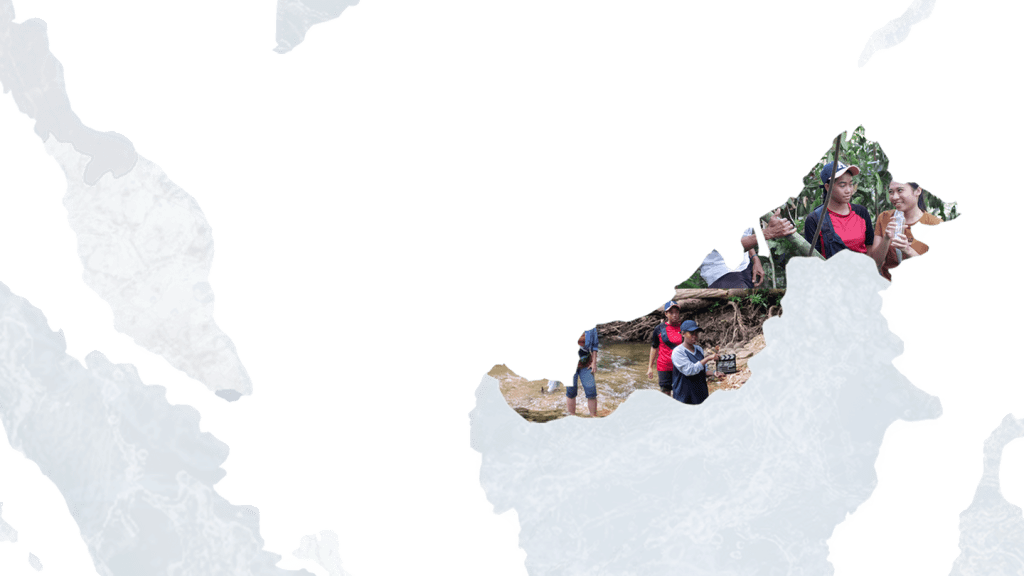

myBALIKpulau 我的浮羅山背
Initiated by Arts-ED
2005-2010
Penang, Malaysia
Amplifying the Voices of Young Indigenous Women
Initiated by Freedom Film Network
2018-2021
Malaysia
Overcoming Hardship in Times of Crisis
Initiated by Parastoo Theatre
2020-2021
Malaysia
The Malay peninsula has for millennia been home to diverse transnational diaspora, due to its strategic position between a globalised east-west trade route and its centrality within the Malay trading archipelago. Its transnational diaspora of immigrants include traders from the region as well as foreign labour brought in by the British colonial government. Though detailed population statistics for 2022 have not been made available by the Department of Statistics the breakdown of population by ethnicity can be estimated at approximately 55.9% ethnic Malays, 22.4 per cent Chinese, 13.9 percent indigenous peoples (orang asli), 6.8 per cent Indians and 1 per cent others (Department of Statistics Malaysia, 2022). [1]
It is interesting to note how over the course of history, cycles of interaction between historical occupants and newcomers has necessitated political, social, economic and cultural negotiation and adaptation. After Malaysia gained independence from British rule in 1957, managing tensions and demands between national and diasporic ideology became a challenge for the state. Even as the construct of multi-culturalism is used to promote national identity and unity, colonial instruments such race-based compartmentalisation in the cultural, political, educational and economic sphere continue to be rationalised and manoeuvred by the elite in order to maintain the status quo. As a result ‘…an exclusionary discourse of race and ethnicity has emerged alongside an inclusive discourse of nationalism…’ [2]
Over the course of Malaysia’s post-colonial history, culture has played a very significant role mobilisation, development and reform. Referencing Gramsci’s theory of cultural hegemony (Gramsci 1971), it can be said that the political elite in Malaysia has used cultural ideology, centralised institutions and policies to propagate ethnic and religious polarisation that has resulted in declining social and economic fluidity of movement within Malaysian society and a decline in the autonomy of civil society which has become dependent on state controlled systems. Political analyst Bridget Welsh notes how in Malaysia’s post-independence history, the manipulation of race and religious polarisation has “scuttled efforts to reach political compromises, constrained the adoption of much-needed reforms, and fuelled political instability. [3]
Within the evolving context of colonialism, nationalism and globalisation activists artists in Malaysia have played an instrumental role in opposing cultural hegemony propagated by the political elite. These artists exercise their agency as architects of culture by recording cultural history and experiences, intervening in cultural policy making, contributing through civic art projects and critical discourse that articulate bottom-up needs and ideas. Their contributions challenge top-down values, norms and vision and help build civic capacity to think and act critically.
Some trends can be discerned in the involvement of arts workers in social and political activism throughout Malaysia’s post-colonial era. ASAS 50 (Angkatan Sastrawan 1950) was a the literary activist association formed in post-war Malaysia that opened up the debate on ‘Art for Society’ versus ‘Art for Art’s Sake’. It also promoted nationalism through language and written works. In the development era of the 70’s, 80’s and 90’s attempts by activist artists to promote a more inclusive national identity was manifested in cultural collaborations, expressions of cultural hybridity in artworks and socially orientated projects. There were also activist academics and arts organisations dedicated to conservation and safeguarding of regional cultural art forms and cultural landscapes which were threatened by development or commercial exploitation.
In 1998 the arts community in Kuala Lumpur came together in response a political crisis situation to form a loose coalition called APA (Artis Pro Activ) which worked closely with NGOs to support protest activities and human rights workers and organised art festivals displaying activist art. In the post-development era after 2000 activist artists began to address transcultural and transnational issues around urbanisation, climate change, cultural rights, etc. These activists were more intent on working together with other professionals in order to achieve real social results.
Socially engaged arts practice can be distinguished by the manner in which it brings real problems or conditions that affected communities on the ground into the realm of art or culture-making and by the integration of social strategies into the art project. Socially engaged arts has emerged as counter-narrative to state-controlled cultural institutions by taking a more humanist as opposed to materialist or essential view of culture. It is critical and fluid in approach, working with community and stakeholders to re-evaluate social structures and practices, activating the society’s creativity capacity to find new ways of thinking and doing. It accommodates the diversity of cultural landscapes and practices, knowledge and aesthetics, and positions community and stakeholders as actors or change agents in tackling issues of concern. Outputs are varied and diverse; collaborative exhibitions or festivals, activation of public realm, rehabilitation of environment, skill sharing, capacity building, etc.
Three socially engaged art projects from the post-development era (2000 until the present), led by three different art groups, have been selected for this exhibition to demonstrate the general characteristics of this contemporary art form in Malaysia. The three art projects engage with different marginalised communities – indigenous communities in peninsular Malaysia, urban refugee communities in Kuala Lumpur and a semi-agricultural community on the island of Penang. The projects take place at a human scale, engaging small communities as participants and/or spec-actors. Each art project is contextualised by the particular community’s physical site, human geography and current community conditions and concerns. The projects are iterative incorporating several phases that may stretch over a few months or years.
The three case studies demonstrate how different artistic practices- photography, film-making and drama have been used to reposition the community as actors in disrupting, remaking, and reimagining their cultural situation. Trained facilitators help animate self -representation, self-reflection and even self-expression through the use of art mediums which enable the community to voice their concerns, tell their stories and communicate their world view.
These art projects invite different degrees of social participation and active citizenship from communities and other civil society partners. The art-making process utilizes creative approaches to involving community in contextual research and identification of community concerns, in building community relations and capacity and in activating community agency in problem solving. Projects aim at bringing about some degree of awareness, capacity building or improvement of personal, social or environmental conditions. As stated by the Indonesian art activist Moelyono ‘everyone has the potential to produce culture’.[4]
In the three case examples, the mapping of place, stories, memories, issues, knowledge and even self-identity is an important starting point. Project participants, re-examine the community’s cultural history, experiences and realities using both activist and artistic modes of working. Another common component shared by the three case examples is the element of consultation and partnerships with stakeholders within and outside the community that provide logistical support, capacity building and cultural sharing. Working on immediate and authentic problems faced by the community, sharing and collective problem solving are important factors that enhance community and stakeholder engagement.
The art projects are not so concerned with art as object or product but more so with the collective art-making process. The projects tend to use lateral rather than hierarchical structures to facilitate the exploration of the multiplicity and complexity of human relations and identity through art. Besides providing a platform for the communities to explore their own conditions and identities the projects also provide an opportunity for the community to present their collective self to ‘the other’, via public sharing and discourse. inviting the other into a dialogue regarding their situation and world view.
All three projects highlight the relational aspect of art-making that provides a platform for members of the community and stakeholders to engage, share and exchange with an- ‘other’. The process of discovery of similarities and differences, intersections, and interdependencies that allow for the widening and deepening human relations create a shift in thinking within and without the community and to relational structures. While the art-making process helps community understand their own context, the output helps community critically reframe their view of themselves.
The three projects demonstrate how socially engaged arts in Malaysia attempts to adopt the principles of participation, collaboration and activism to create change within the community as well as outside of the community . Socially engaged arts provides a platform for humans to converse, dialogue and interact. The relational approach taken in all three projects aids in identity-making, development of the community’s cultural agency and in cultural bridging. Ivan Ilitch distinguishes between conviviality as opposed to capitalist productivity, emphasising the need to have tangible and intangible tools that would encourage new and diverse social possibilities and a just distribution of power as opposed to increased competitiveness and hierarchy.
Needless to say, socially engaged arts is associated with conviviality as opposed to the production of artistic work commissioned by municipal authorities or developers for purpose of gentrification. If artists wish to avoid accusations of complicity, ideas for place and community development should be co-developed with contributions from local community, and should incorporate local knowledge and resources. The bottom up cultural politics of socially engaged arts needs to be recognised and acknowledged as constituting a social good that does not require justification via cost-benefit considerations or market opportunities. [5]
Department of Statistics, Malaysia 2022
Ilich Ivan (1973) Tools of Conviviality, Harper and Row, New York
Laimer C. and Rauth E. 2014. Catch 22 Or: When Doing Nothing Is No Solution. Urban Artistic Action in the Neoliberal City. In: The Art of Urban Intervention, Vol 4 of the series Culture of the Public Space, edited by Laister et al, 266-278, Vienna: Centre for Contemporary Art
Moelyono.1998. ‘Mendudukkan Rakyat Sebagai Subject’, in Utan Kayu: Tafsir dalam Permainan, 207–16, edited by A.Sahal, A.Utami, E. Endarmoko and S.Srengenge, Jakarta: Yayasan Utan Kayu
Nair S. 1999. Constructing civil society in Malaysia: Nationalism , Hegemony and Resistance. In: Rethinking Malaysia Malaysian Studies 1 edited by K.S. Jomo, 84-106, Hong Kong
Welsh B. 2020. Malaysia’s Political Polarisation: Race, Religion and Reform
In: Political Polarization In South And Southeast Asia: Old Divisions, New Dangers
Edited by Thomas Caothers, Andrew O’Donohue pp 41-52, Washington DC: Carnegie Endowment for International Peace.
https://carnegieendowment.org/files/Political_Polarization_RPT_FINAL1.pdf