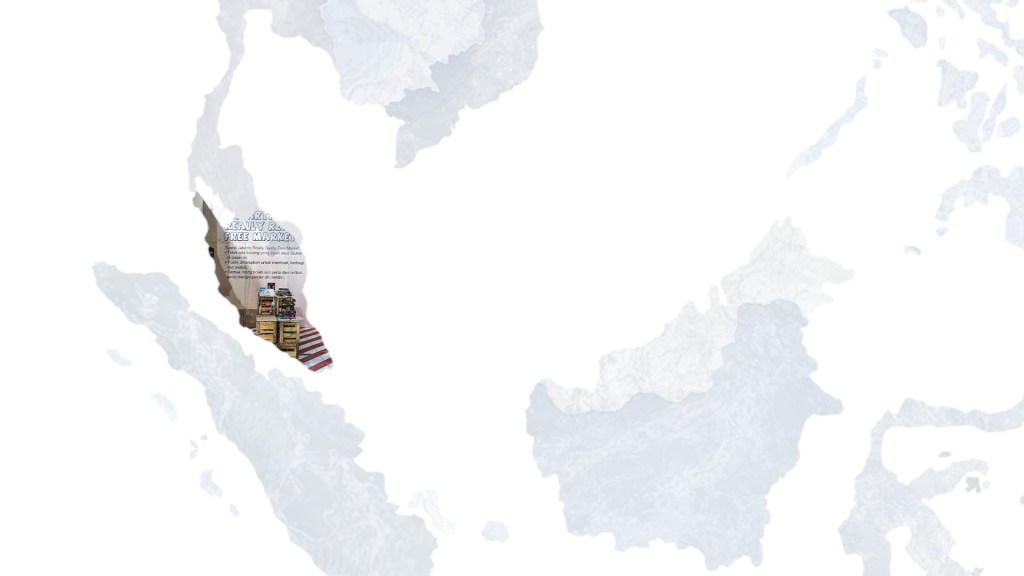

Initiatives by Post-Museum:
Really Really Free Store
Initiated by Post-Museum
Since 2009
Singapore
Renew Earth Sweat Shop
Initiated by Post-Museum
2020-2021
Singapore
“Legacy Blankets (To cherish and to hold)” and “Wind Blankets”
Initiated by Shirley Soh
2018
Exhibited at Both Sides, Now 2018: CLOSER, Singapore
The School Never Asked
Initiated by Felicia Low, story by Felicia Low and the Three, illustrated by Joy Ho, colours by Xiao Yan
2014
Singapore
Autogenous Culture as Socially Engaged Art in Singapore
Autogenous culture [1] refers to forms of life that exceed formal modes of regulation and accountability. Autogenous cultural practices take their cue from everyday life transactions and exchanges, which may be influenced by the state but are in no way predetermined by the state in terms of compliance or resistance. Theoretically, the term ‘autogenous culture’ has been used to imagine such a space as a politically able space in Singapore, thereby recognising that life practices on the ground can be a source of inventive inspiration to obstacles, if we appreciate and study them for value, defined in their own ways.
Modern Singapore began in 1819, when it became a British colony, backed by its entrepôt trade relations with the British East India Company. An independent state with its own self-elected government, Singapore welcomed various forms of foreign investment in the country which provided for jobs and raised the capitalistic value of its citizens in terms of skills, knowledge and abilities to meet global economic challenges. Part of this survival strategy included formally transforming the educational system into a national one, which taught mainly in English. Subjects, such as Literature and Art, also leaned towards Western forms and measures of achievement in national mainstream schools.
By the 1990s, Singapore had become one of the four ‘Asian Tigers’ renowned for its rapid economic growth.[2] In many ways, its trade priorities with the West during colonial times extended into the era of globalisation which took place over the 1980s to the 1990s. Capitalistic priorities in turn had an impact on other ways of life, generating a preference for consumeristic, commercialised exchanges which maximised gain and minimized risk – resembling a neoliberalistic society where prosperity achieved through self-responsibility and the preservation of self-interest became key to maintaining a stable governance of the local population (Low 2017).
By 2000, Singapore had become part of the global art network through the set-up of contemporary art institutions, such as the National Gallery Singapore, and its participation and organization of a myriad of international art exhibitions and art fairs. Artists in Singapore have responded in a diverse way to these initiatives. While some have become part of an increasingly commercialised and globalised art enterprise, others have found ways to highlight other ways life have been led, or can be led, apart from capitalistic or neoliberal preoccupations. The Artist Village, a collective of artists who created work in a more local, or ‘kampung’, environment in the late 1980s, became known for presenting social issues via various forms of contemporary art, such as installations and performances. Over time, due to a lack of space, this group became more nomadic. They also became more prominent in influencing younger generations of artists towards envisioning a more critical, more involved form of visual art which wanted to play a proactive role in Singapore society. [3]
Socially engaged art practices are now quite well-practiced by a number of artists in Singapore. Exploration of how art can become part of the lives of the people, in ways beyond capitalism and consumption, has generated a range of art initiatives that take place on the ground. Some of these initiatives support national agendas that seek to harmonise and deepen local civic participation. Other initiatives seek to critique and question ingrained social norms which result in real and perceived forms of negation, discrimination or exclusion of particular ways of life. The latter form of initiatives is not part of any national impetus, nor are they works that are governmentally resistant. The artwork from these initiatives seek out how lives are led, differently, independently, regardless of national priorities. Indeed, they attest to how one can survive and even thrive in situations of negation, neglect, or exclusion. In other words, these initiatives seek to understand autogenous cultural practices, presenting ways of life, through art, that can tell us more about how to live in an increasingly regulated and complex world, paving the way for new social concepts, global concepts and, of course, new art forms to emerge.
The three artworks presented in this exhibition by Singaporean artists, Shirley Soh, Post-Museum and Felicia Low offer glimpses into forms of autogenous culture on the ground in Singapore. Entitled ‘To Cherish and To Hold’, Soh worked with 8 senior women at a local housing estate named Chong Pang in 2018. This community was fluent in Chinese dialects and Mandarin, having been either educated in vernacular schools of the past, or having had little formal education in their younger years. They also had little formal experience with art. Soh spent time chatting and working with the women to understand better the symbolic meaning and functional use of traditional funeral blankets in Chinese culture. Through this project, the women created Legacy Blankets that expressed images and text which they would like to pass on to their loved ones, together with Wind Blankets which carried images of themselves in their last position before they passed on. These blankets were displayed outdoors, exposed to the elements as a reminder of the last journey in life as one returns to nature. This project was part of an arts programme, ‘Both Sides Now’ presented by Drama Box, Artswok, Lien Foundation and Ang Chin Moh Foundation, in collaboration with Yishun Health.
Post-Museum, founded by Woon Tien Wei and Jennifer Teo in 2007, is an independent cultural and social space in Singapore which aims to encourage and support a thinking and pro-active community. Post-Museum, over the years, has presented different ways of exchange and relations, which build on the resources of the community to nurture mutuality and renewal. The Really Really Free Market (RRFM) has been taking place bi-monthly in Singapore since 2009. A more modest set up at this exhibition encourages viewers to pick up what they like and to exchange it for an item of their own. At RRFM, nothing is for sale and everything is shared freely, generating mutual goodwill exchanges at no capitalistic gain nor cost. The concept of renewal is also addressed through video documentation of the Renew Earth Sweat Shop. In this community art project, participants upcycle used clothes creating an alternative system of fashion exchange which plays no part in the exploits of the global fashion industry. With the Renew Earth Sweat Shop, the everyday, local fashion choices of participants come to the fore as generic fashion items morph into items of personal quirks and fancy.
‘The School Never Asked’ was a collaborative project between Felicia Low and three young women who had come from the Normal Technical Stream of secondary school education, an educational stream which caters to vocational training for students who are perceived to be less academically inclined. Each of these women identified as heterosexual, bisexual and homosexual respectively. Together, they told stories of how they fell in love as teenagers, regardless of state and school policies on non-heterogenous sexual identities and celibacy for youth. They also gave advise on how to have good and healthy relationships. Part of The Substation’s Associate Artist Research Programme between 2012-2014, all of their stories and advice were illustrated as a comic book by two other young women, in consultation with the authors and Felicia. This comic book is available online as a free resource for other teenagers who are finding out about love and relationships. It also highlights the reality that growing up exceeds the limits of governmental and institutional policies. The young will always be the authors of their own culture.
These three artworks present a microcosmic view of a myriad of socially engaged art practices in Singapore. It remains to be seen if participatory, socially engaged works are able to create mainstream cultural spaces, thereby becoming ‘disappearing’ forms of art, as new forms of life and culture determined by the ground gain strength of presence. By then, a research exhibition such as this would suffer an identity of crisis – Visual art? Sociology? Geography? Economics? This identity crisis would paradoxically be our marker of success.
Low Felicia. (2019). “Autogenous Culture As Political Form: Explorations through Participatory Arts Practices In Singapore”. Inter-Asia Cultural Studies, 20:1, pp. 65-72.
Gulati, UmeshC. (1992). “The Foundations of Rapid Economic Growth: The Case of the Four Tigers”. The American Journal of Economics and Sociology, 51:2, pp. 161-172.
Singapore Art Museum & The Artist Village (2009). The Artist Village 20 Years On, http://www.tav.org.sg/files/TAV20YearsOn.pdf