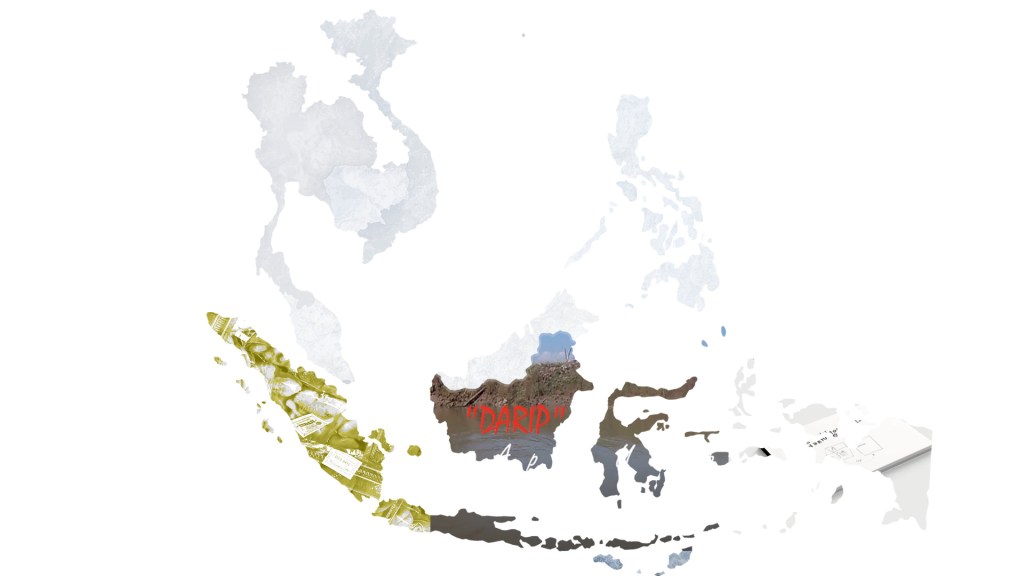

Festival Film Bahari
Initiated by Cinema Cirebon
Since 2018
Cirebon, Java, Indonesia
Bakureh Project
Initiated by Gubuak Kopi
2018
Solok, West Sumatra, Indonesia
Memorama (music album) and What We Feel During an Earthquake (book)
Initiated by Forum Sudut Pandang
2019
Palu, Central Sulawesi, Indonesia
Many in One. Nurturing Diversity and Inclusion.
The three collectives presented in the research exhibition focus on ecological issues and safeguarding intangible heritage. Their holistic and organic workflows and inclusive procedures are comparable to the work of other socially engaged art collectives in Indonesia. Since 1997, the country has seen a continuous increase in art collectives committed to working closely with communities. There is thereby notable interplay between the safeguarding of intangible cultural heritage, exploration of its use for current challenges, and transformation of traditional knowledge into imaginaries and actions for a future worth living in.
Artists have addressed socio-cultural and socio-political topics and incidences in their work throughout the 20th century and received art-historical attention. Following the Asian Financial Crisis in 1997, thousands of students took to the streets of Jakarta. They were enraged by Suharto’s authoritarian regime, crony capitalism, and the mishandling of the economic crisis. As a result, this upheaval led in 1999 to the Era Reformasi, the return to democracy. Regarding art, on the one hand, the currency devaluation triggered an art market boom in which artists produced works on-demand, trying to keep up with requests. On the other, inequalities, formal and elitist understandings of art, classist attitudes, and top-down expertism have been subject to greater critique.
Several collectives, now internationally-renowned, emerged in the decades that followed, including Cementi Art House, Jatiwangi art Factory, KUNCI, Lifepatch, Pasir Putih, ruangrupa (documenta15’s curatorial team), MES65, Visual Art Archive, and WAFT. Important values underpinning their activities are that “everyone is an artist,” that “everyone is an expert,” and that co-creation be done intergenerationally.
This development is particularly significant against the backdrop of the many diverse, complex settings in Indonesia captured in its national motto: “Bhinneka Tunggal Ika” (Unity in Diversity). Indonesia is home to over 270 million people and is the fourth most populous country globally. It has the second largest coastline and has seen thousands of years of trading, immigration, passers-by, foreign powers, peaceful and violent encounters, and multifarious influences. As a result, Indonesia exhibits immense biological, genetic, cultural, traditional, religious, ethnic, and linguistic diversity. There is one official language, Bahasa, and more than 700 additional languages are spoken. There are over 1,300 ethnic groups and hundreds of traditional and religious belief systems with around 87% of the population being Muslim. As of 2022, nearly 60% of the population live in urban areas.
We approached research on these collectives through art practitioner and global studies paradigms and with a particular interest in reciprocal relationships between collectives, communities, and policy-makers. Based on these criteria, we selected Festival Film Bahari, Gubuak Kopi, and Forum Sudut Pandang: the collectives i) focus on ecological issues and safeguarding intangible cultural heritage, ii) were formed in the last decade or so, iii) are based on three different large islands, iv) do arts-based and transdisciplinary work, and v) can be contacted within the available time window (some collectives work in remote places and are not easily reached). Ika selected the collectives and evaluated her choices with some of her peers. We conducted desk research and interviews (in Bahasa, translated into English). Ika spoke with Kemala Asthika, founder of Festival Film Bahari; Albert Rahman Putra, founder of Gubuak Kopi; and Taufiqurrahman, founder of Forum Sudut Pandang.
Gubuak Kopi (Solok, West Sumatra) is a non-profit cultural studies and development organisation that has been gradually developing since 2011. Gubuak Kopi translates to “Coffee Hut,” a space to meet, spend time together, chat, and discuss. It started with a group of artist friends, who collected information on local traditions. They had just completed their artist education and were discussing the downsides of living in Solok, which caused many young people to move away to the capital, Jakarta. They also realised that through their education they were heavily influenced by Java-centric narratives and knew little about their local cultures. For this reason, they began exploring their hometown and documenting local traditions, crafts, and food. Gradually, Gubuak Kopi developed into the organisation it is today.
Gubuak Kopi, together with community members, runs various projects documenting local traditions rooted in agriculture. The collective organises collaborations with professionals (artists, writers, and researchers) and citizens. It provides art and media training to youth and students to increase media literacy. Becoming increasingly important is the work it does with community leaders and with policy-making activities. Gubuak Kopi has also developed local media and archiving systems and invites artists for residencies to work with the data collected.
On view at the research exhibition is a recipe and mind-map from the “Bakureh” project, which explores the cultural value of “gotong royong” (joint) cooking. Although gotong royong is a nationwide concept, “Bakureh” looks into the local specificities of passing on knowledge and organising cooking together. Professionals and community members document the variety of food and dishes, related activities, philosophies, and values.
The Festival Film Bahari (Cirebon, Java) held its first festival screening in 2018, following previous engagements with village communities beginning in 2016. Bahari translates to “nautical.” The idea of a festival was seeded when Kemala, a filmmaker and English teacher, was hanging out (“nongkrong”) with filmmaking friends. Although she grew up in one of the neighbouring villages, she and her friends found they new little about the life, traditions, histories, and challenges of coastal life. Moreover, national media coverage of the region was limited to crime. Adding to this dark picture is the memory of a village war back in 2000, when stones were thrown and arrows shot, which left traumatic marks on the community. This is how the idea for Festival Film Bahari grew, contributing to creation of identity, as well as a more positive perception of the region and its maritime cultures.
The festival is both a producer and supporter of short films as well as an organiser of public screenings. The films are produced in intergenerational settings and focus on coastal life. These productions also serve as media training for youth and students. People from the fishing villages contribute to the content of the films and participate as protagonists. These films are then featured at the festival, alongside an (inter)national film selection, which is organised through the submission platform FilmFreeway. The local audience prefers to see the films shot in the area and gets enjoyment from knowing the characters in the films. The national and international guests join the festival at their own expense, supported by accommodation packages at village homes, which are organised by the festival team.
On view at the research exhibition is a compilation of films shown at the festival between 2018 and 2021. The compilation is put together by the Festival Film Bahari team.
The Forum Sudut Pandang (Palu, Central Sulawesi) got started by a group of artist friends and students in 2016. Forum Sudut Pandang translates to “Point of View Forum.” They have held art exhibitions, workshops, and film screenings, and organised film production, music gigs, and community markets. In Palu, according to Taufiqurrahman, there are no art institutions, and thus activities from the Forum Sudut Pandang provide an important and much-needed gathering, sharing, and co-creation space for creatives, audiences, and visitors.
Palu is located in the Pacific’s “Ring of Fire,” the most seismically active region on the planet, and is thus prone to natural disasters. The most recent massive earthquake and tsunami to hit Palu, on September 28, 2018, took the lives of more than four thousand people and left tens of thousands without a home. In the aftermath of the disaster, the Forum Sudut Pandang joined in the post-disaster recovery process. Its arts and cultural activities focus on working through traumatic experiences, documenting the course of events, and providing education on disaster mitigation.
The Forum Sundut Pangang produced, for example, the music album Memorama, which will be presented in the research exhibition. It also published a collection of stories and illustrations, discussing the experiences of 423 children who survived from Mamboro, Komodo, Loru, Sidera, Tipo, Tavaili, and Rogo. The book is titled What We Feel During an Earthquake (Yang Kitorang Rasa Waktu Gempa). Currently, the collective works on archival systems to keep the stories, illustrations, and audio files accessible.
To conclude this case study information, what follows is a summary of some shared, essential features of the work done by the above collectives.
All three collectives were started by individuals who observed challenging socio-cultural and economic developments in their home environments: rural exodus, migration to mega-cities, detachment from the direct environment due to digital distraction and business, decreasing connection and empathy between people, natural disasters, and traumatic experiences. These individuals, together with their friends, began their collective work and consistently broadened their circle of co-creators and the various groups involved.
These collectives share an interest in intersecting traditional knowledge and values with the current challenges in their home region. They foster physical and mental co-creation spaces and bring together people from all walks of life. They all have expressed that what works best is to do various activities at once, that is, taking a holistic approach. These activities include artistic activities, knowledge sharing among professionals and community members, intergenerational gatherings, having fun together, education and skills training, exploring, and imagining. Bonding in this way is the most valuable outcome, as it lays the groundwork for preserving intangible heritage and projecting the future. Appreciation for tradition and explorative transformation, creation and development are thereby equally valued. Rediscovering and experiencing traditional ways of doing things, becoming aware of habits and beliefs — this is fused with artistic documentation, production, imagination, and dreaming. It is, therefore, a reciprocal process: continuously interlinking tradition, co-creation, and projecting the future. This fusion is seen as a powerful creative force for building social capital.
Indonesia’s 2020 Population Census Result. OIC-StatCom, https://www.oicstatcom.org/event-detail.php?id=2478 (5 April 2022).
Jatiwangi art Factory. Paririmbon Jatiwangi. Jatiwangi: Jatiwangi art Factory and Yayasan Daun Salambar, 2016.
Jurriëns, Edwin. Indonesian Artivism: Layers of Performativity and Connectivity. In: Australian and New Zealand Journal of Art. 20, no. 2(2020): 231-252.
Kent, Ellen. Entanglement: Individual and Participatory Art Practice in Indonesia. Dissertation. Canberra: The Australian National University, 2016. https://doi.org/10.25911/5d5146060c32c
Maula, Jadul. “Arab Adapted, Java Embraced”: Creativity in the Cultural Relationship between Nusantara and the Arab Region. In A Path of Pot Holes. Navigating the Edges & Vortex of The Indonesian – Arab Region Relationship through Biennale Jogia XII 2013, edited by Yoshi Fajar Kresno Murti, 94-114. Yogyakarta: Yogyakarta Biennale Foundation, 2014.
Steinkamp, Anna, ed. Creative Responses to Sustainability. Cultural Initiatives Engaging with Social and Environmental Issues. ASEF culture360. Connecting Asia & Europe Through Arts & Culture. Singapore: ASEF.